


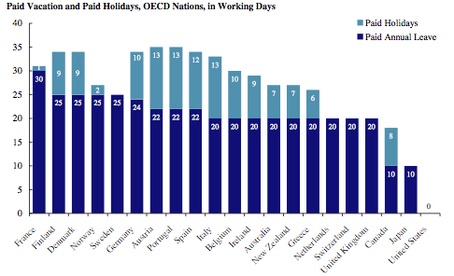
Pollsters find time stress a constant complaint among Americans. Until the current recession, Americans were working some of the longest hours in the industrial world.
Conservatives say this is all voluntary: American just like to work a lot. But Gallup’s daily survey finds them 20 percent happier on weekends than on workdays—what a surprise! And when Americans rank the pleasure their daily activities bring, working ends up second from the bottom (socializing after work is second from the top!), more pleasurable only than that mother of all downers, the morning commute.
By contrast, the Netherlands boasts the world’s shortest working hours. Dutch workers put in 400 fewer annual hours on the job than American workers do. And yet, the Dutch economy has been very productive. Unemployment (at 5.8 percent) is much lower than in the United States, while the Netherlands boasts a positive trade balance and strong personal savings. A Gallup survey ranks the Dutch third in the world in life satisfaction, behind only the Danes and Finns, and well ahead of Americans.
The Dutch have been reducing time on the job through work-sharing policies since the 1982 Wassenaar Agreement, when labor unions agreed to modify wage demands in return for more time. Their Working Hours Adjustment Act (2000) require that employers allow workers to cut their hours to part-time while keeping their jobs, hourly pay, health care, and pro-rated benefits.
Anmarie Widener, a health researcher and part-time instructor at Georgetown University, was impressed by the Dutch devotion to time for family and recreation she witnessed while getting her Ph.D. in the Netherlands. Her dissertation compares life satisfaction among Dutch and American parents. Not surprisingly, she says, “My polling showed that in almost every area of life, Dutch parents are substantially more satisfied than their American counterparts.” And so are their children. A 2007 UNICEF study ranked children’s welfare in the Netherlands as the highest in the world. By contrast, the United States was twenty of twenty-one wealthy countries studied, barely edging out the United Kingdom.
Work sharing may be all the more important in times like the present. Economist Dean Baker argues that any further economic stimuli should include Kurzarbeit, or “short work,” a German policy that encourages employers to reduce hours rather than lay workers off when times are tight. Instead of cutting 20 percent of the workforce, a German company might reduce each worker’s load by a day. Unemployment benefits kick in for the reduced work time, so workers earn roughly 90 percent of their former incomes for 80 percent of the work.
Other countries have followed suit—the French believe in “working less so all can work.”
Here in the United States, a bill sponsored by Senator Jack Reed, Democrat of Rhode Island, and Representative Rosa DeLauro, Democrat of Connecticut, would allow federal unemployment benefits to be used to top up salaries of reduced-hour workers in the United States. When the bill was discussed in Barney Frank’s House Financial Services Committee, not only did Dean Baker testify in favor but so did Kevin Hassett, an economist with the conservative American Enterprise Institute.
Hassett pointed out that even though the Germans’ economy tanked like ours did in 2008, their unemployment rate hasn’t risen—thanks to Kurzarbeit. The law allows companies to retain workers instead of having to rehire later, he said. It’s good for them, good for the workers, and doesn’t really cost any more than traditional unemployment payments. It’s a win, win, win. Nonetheless, not a single Republican has supported the bill and not all Democrats do either, so it remains in limbo.
Shorter working hours—the roses of “Bread and Roses” fame—are part of a long and progressive American tradition. A famous Dorothea Lange photo from 1937 shows a National Association of Manufacturers billboard on a hardware store. It reads: “World’s Shortest Working Hours—There’s No Way Like the American Way!” A bill passed the U.S. Senate in 1933 that would have made the official workweek only thirty hours long. Presidents from FDR to Richard Nixon called for reducing working hours.
In our time, feminist and women’s groups, including MomsRising.org and the National Partnership for Women and Families, have led the way in promoting work-life balance policies, demanding paid family leave, paid sick days, and flexible hours. Congressman Alan Grayson of Florida has introduced a bill calling for mandatory paid vacations, guaranteed by law in almost every country. The United States joins Burma and a handful of others that don’t offer this basic benefit.
As Juliet Schor makes clear in her new book, Plenitude: the New Economics of True Wealth, shorter work time also makes environmental sense. Planetary restraints and climate change require us to reduce our consumption of resources. Demands for quick extraction of resources lead to catastrophes like the oil volcano beneath the Gulf of Mexico.
As productivity increases, we seem faced with a choice between environmental disaster or massive unemployment. Unless, of course, we slow down by reducing working hours and sharing the work. Half a century of economic growth has not increased our happiness. More free time might well do so. It will certainly improve our health.
Americans will exercise more, sleep more, garden more, volunteer more, spend more time with friends and family, and drive less. We need full employment, but not by returning to the unhealthy overwork of recent decades As Derek Bok puts it in his new book, The Politics of Happiness:
Progressives would do well to advocate reduced working hours instead of demanding unsustainable growth. Suzy Ross, who teaches at San Jose State University, told me that when her co-workers found that they would have to take furlough days and commensurate pay cuts in response to California’s budget crisis, they all responded in anger. Now, she says, they appreciate the extra two days off each month, and few want to give them up, though they could use the money.
Reducing work hours and sharing available work is essential for our families, health, economic security, and the environment.
It’s time to get on with it.
image via


0 comments:
Post a Comment